U.S. v. Heppner · S.D.N.Y. · Feb. 2026
A defendant’s exchanges with a consumer AI platform were protected by neither privilege nor work product. The court pointed to the provider’s policy allowing retention and disclosure.
Privilege Note
Transcripts, speaker labels and summaries, produced entirely on your firm’s own server. No copy ever reaches us or any AI company.
Request a demo1 in 3
U.S. workers say an AI notetaker has sat in on their meetings.
25M+
people use Otter alone, across more than a billion meetings.
3×
year-over-year growth in monthly users of Zoom’s AI Companion.
Much of the business world has adopted it. Law firms, where meetings are often privileged, largely can’t.
Sources: Kolmogorov Law / Pollfish survey of 500 U.S. workers, July 2026 · Otter.ai, March 2025 · Zoom Q4 FY2026 results
01
Popular notetakers like Otter, Granola and Fireflies process meeting audio on a vendor’s or AI provider’s servers.
02
Once a privileged discussion sits on someone else’s infrastructure, the firm no longer controls who can reach it.
03
Cautious firms bar AI notetakers from client matters, and lawyers go back to taking notes by hand.
U.S. v. Heppner · S.D.N.Y. · Feb. 2026
A defendant’s exchanges with a consumer AI platform were protected by neither privilege nor work product. The court pointed to the provider’s policy allowing retention and disclosure.
Ambriz v. Google · N.D. Cal. · Feb. 2025
Letting wiretap claims over an AI call-transcription tool proceed, the court looked at whether the vendor was capable of using the data, not whether it did.
Wiretap and biometric (voiceprint) claims survived a motion to dismiss in Aug. 2026.
Proposed class action filed July 2026 on a similar theory.
Plain-English summaries, not legal advice. Ambriz was decided at the pleading stage. Status as of October 2026.
Data held by: vendor
Audio goes to the vendor’s cloud. A privacy policy and a contract are what protect it.
Data held by: vendor
A dedicated copy, still in the vendor’s cloud and under the vendor’s control.
Data held by: your firm
Runs on your firm’s server. We never receive audio, transcripts or notes.
“Zero data retention” is a promise. Never having custody is an architecture.
Inside your firm · your office or your own cloud account
Records the meeting and sends it to your server.
Review and edit, filed under the matter.
One Linux server · No GPU required · Air-gap ready
0 outbound connectionsOutside your firm: no connection
Never contacted.
0 external AI calls
No copy ever reaches us.
License checked offline
Nothing reports back.
Telemetry: none
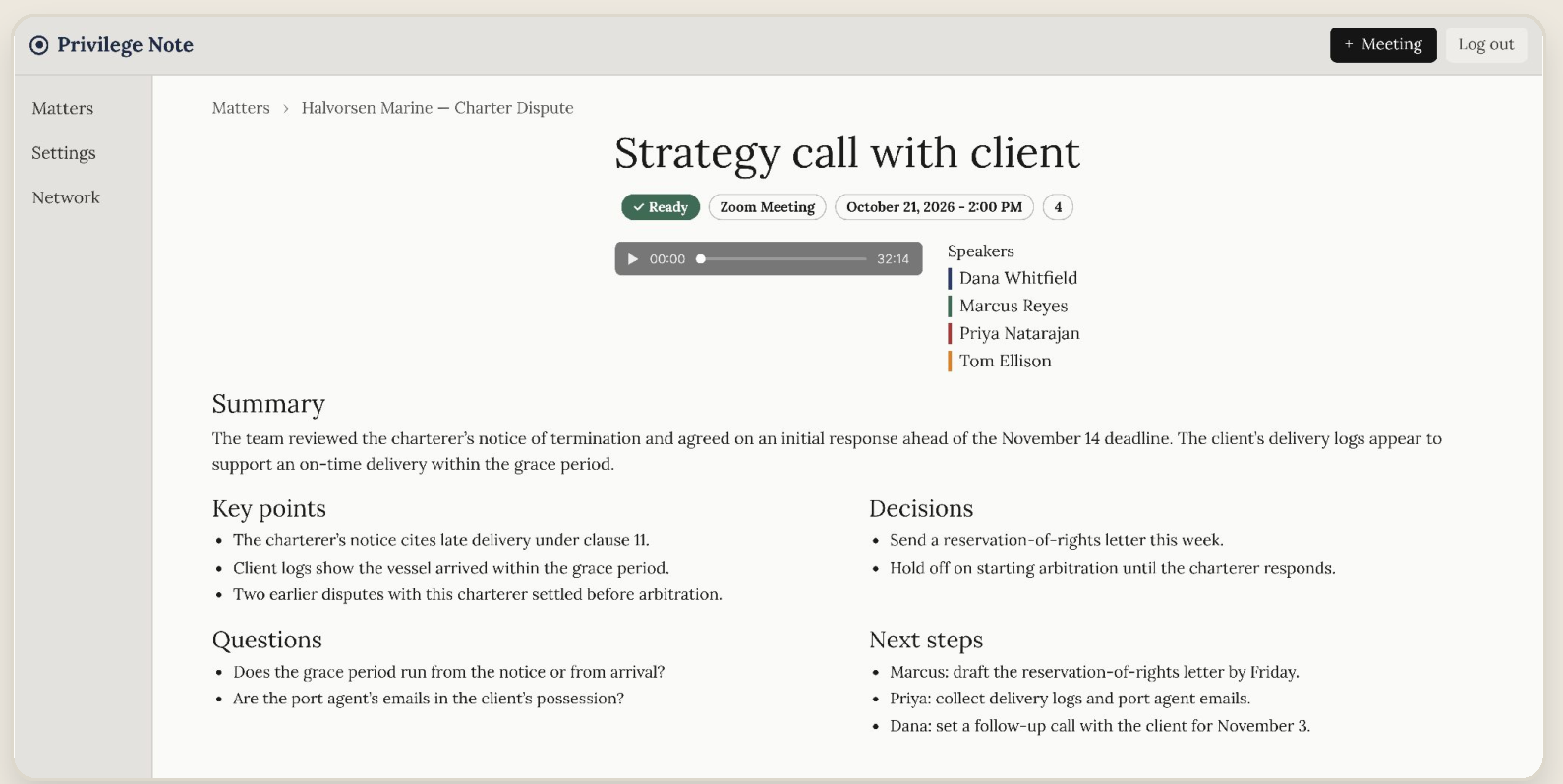
Names display for transcript diarization. No voiceprints are stored.
Key points, decisions, questions and next steps, drafted on your server.
Each meeting lives under its client matter, with per-matter access.
| Component | What it is |
|---|---|
| Deployment | Docker on one Linux server, in your office or own cloud account. No GPU required. Air-gapped. |
| Outbound traffic | None. No calls to AI companies, to us, or for telemetry. License checked offline. |
| Speech to text | Parakeet-TDT 0.6B v3 |
| Speaker labels | pyannote segmentation 3.0 and TitaNet-Large, within a single meeting only |
| Summaries | Gemma 4 open-weights model, run with llama.cpp |
| Storage | PostgreSQL 18 on an encrypted volume, with a per-firm key |
| Transport | TLS between the laptop, the server and your attorneys |
| Capture app | Signed app for macOS and Windows |
Reflects the current build. Model versions may change as better open models are released.
Working today
Next
Later
Order and timing are shaped with our design-partner firms.
“What did the client actually say in March?” takes seconds, not digging.
Matter context stays with the firm when people move on.
Clean, matter-linked notes inside your walls, ready for whatever AI your firm adopts next.
Keeping privileged conversations in-house is the reason to adopt. This is the upside.
Step 1
Your IT and security teams review the architecture and test it on their own terms.
Step 2
A practice group uses it on real meetings, on a server you control.
Step 3
Your counsel and risk team reach their own conclusions.
Early firms help shape the product around their workflows as design partners.
Every claim on this page is about where data flows and where it can’t.
The privilege question belongs to
your firm.